
Quantum computation holds the promise to solve certain problems that are untractable on the most powerful supercomputers of today and of the foreseeable future. Several implementations of a quantum processor have been proposed and realized in laboratories around the world. Among these, Ion traps, superconducting qubits and semiconductor spin qubits are the most promising platforms for the realization of a scalable quantum computer.
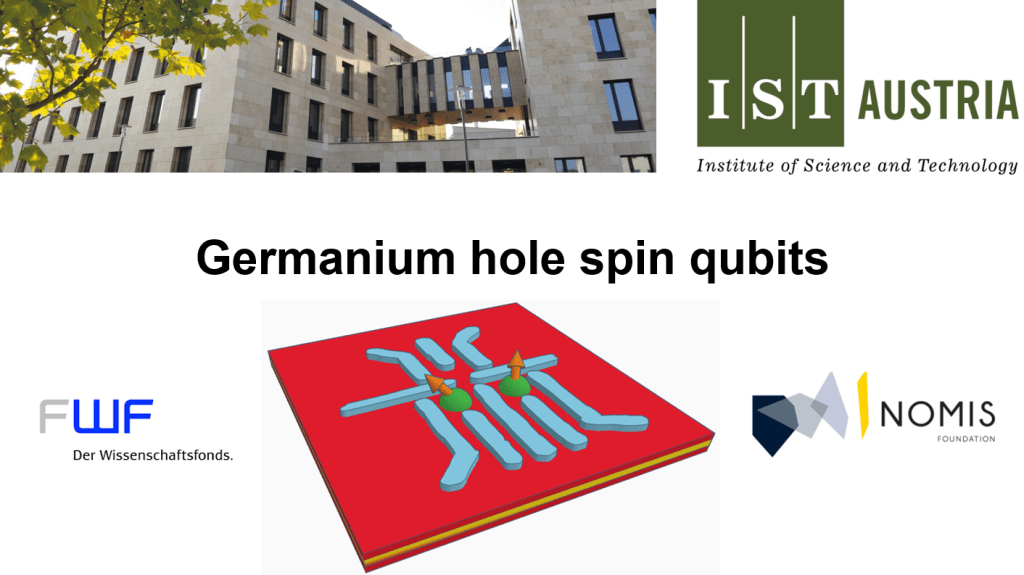
In the Nanoelectronics group we investigate a novel material for qubits: hole gases in Ge hut-wires and 2 dimensional heterostructures [1]. Holes in Ge offer several advantages over the electrons in Si and GaAs. Like Si, Ge is a group IV element. This means that it naturally possesses a low abundance of nuclear spin-carrying isotopes, a major source of decoherence for spin qubits. The p-type wavefunction is predicted to further suppress the contact hyperfine contribution for holes making them an even more attractive candidate for spin qubit implementations. Moreover, Ge can be isotopically purified to yield almost nuclear spin-free materials. Another great advantage of Ge is the presence of a strong and tunable spin orbit interaction which allows all electrical manipulation of the spin degree of freedom without the need for additional micro-magnets. Yet another great advantage is the low effective mass which greatly relaxes fabrication constraints faced by the Si community. Larger and more reproducible devices can thus be realized and have been demonstrated to exhibit very high mobilities [2]. Last but not least, Ge displays Fermi level pinning to most metals which greatly facilitates the creation of ohmic contacts to the carrier gases which can even be proximitized with superconductors to host the superconducting phase [3-5]. All these favorable characteristics have lead to the demonstration of the first hole Loss DiVincenzo qubit in our group in 2018 in a Ge Hut wire [6]. More recently, in 2020, we also demonstrated the first hole singlet-triplet qubit [7,8], this time in a 2 dimensional hole gas in Ge [9]. Here we harvested the tunable spin-orbit interaction which affected the g-factors in adjacent quantum dots to drive our qubit. We reached manipulation speeds exceeding 100 MHz at fields as low as 3 mT, an improvement of a factor of more than 1000 with respect to singlet triplet qubits in Si. The field of Ge qubits is rapidly expanding and is challenging Si as the most promising platform for a large scale quantum computer [10-13].
References:
[1] Scappucci, G.et al. The germanium quantum information route. Nature Reviews Materials (2020).
[2] Lodari, M.et al. Light effective hole mass in undoped ge/SiGe quantum wells. Physical Review B 100 (2019).
[3] Hendrickx, N. W.et al. Gate-controlled quantum dots and superconductivity in planar germanium. Nature Communications 9 (2018).
[4] Vigneau, F. et al. Germanium quantum-well Josephson field-effect transistors and interferometers. Nano Letters19, 1023 (2019).
[5] Aggarwal, K.et al. Enhancement of proximity induced superconductivity in a planar ge hole gas. ArXiv 2012.00322 (2020) (accepted in Physical Review Research).
[6] Watzinger, H.et al. A germanium hole spin qubit. Nature Communications 9, 3902 (2018).
[7] Levy, J. Universal quantum computation with spin-1/2pairs and heisenberg exchange. Physical Review Letters 89 (2002).
[8] Petta, J. R. et al., Coherent manipulation of coupled electron spins in semiconductor quantum dots. Science 309, 2180 (2005).
[9] Jirovec, D.et al. A singlet triplet hole spin qubit in planar ge. ArXiv 2011.13755 (2020) (accepted in Nature Materials).
[10] Hendrickx, N. W., Franke, D. P., Sammak, A., Scappucci, G. & Veldhorst, M. Fast two-qubit logic with holes in germanium. Nature 577, 487–491 (2020).
[11] Hendrickx, N. W.et al. A four-qubit germanium quantum processor. Nature 591, 580 (2021).
[12] Froning, F. N. M.et al. Ultrafast hole spin qubit with gate-tunable spin-orbit switch. Nature Nanotechnology 16, 308 (2021).
[13] Wang, K.et al. Ultrafast operations of a hole spin qubit in ge quantum dot. ArXiv 2006.12340 (2020).
 nanoelectronics group
You must be logged in to post a comment.